
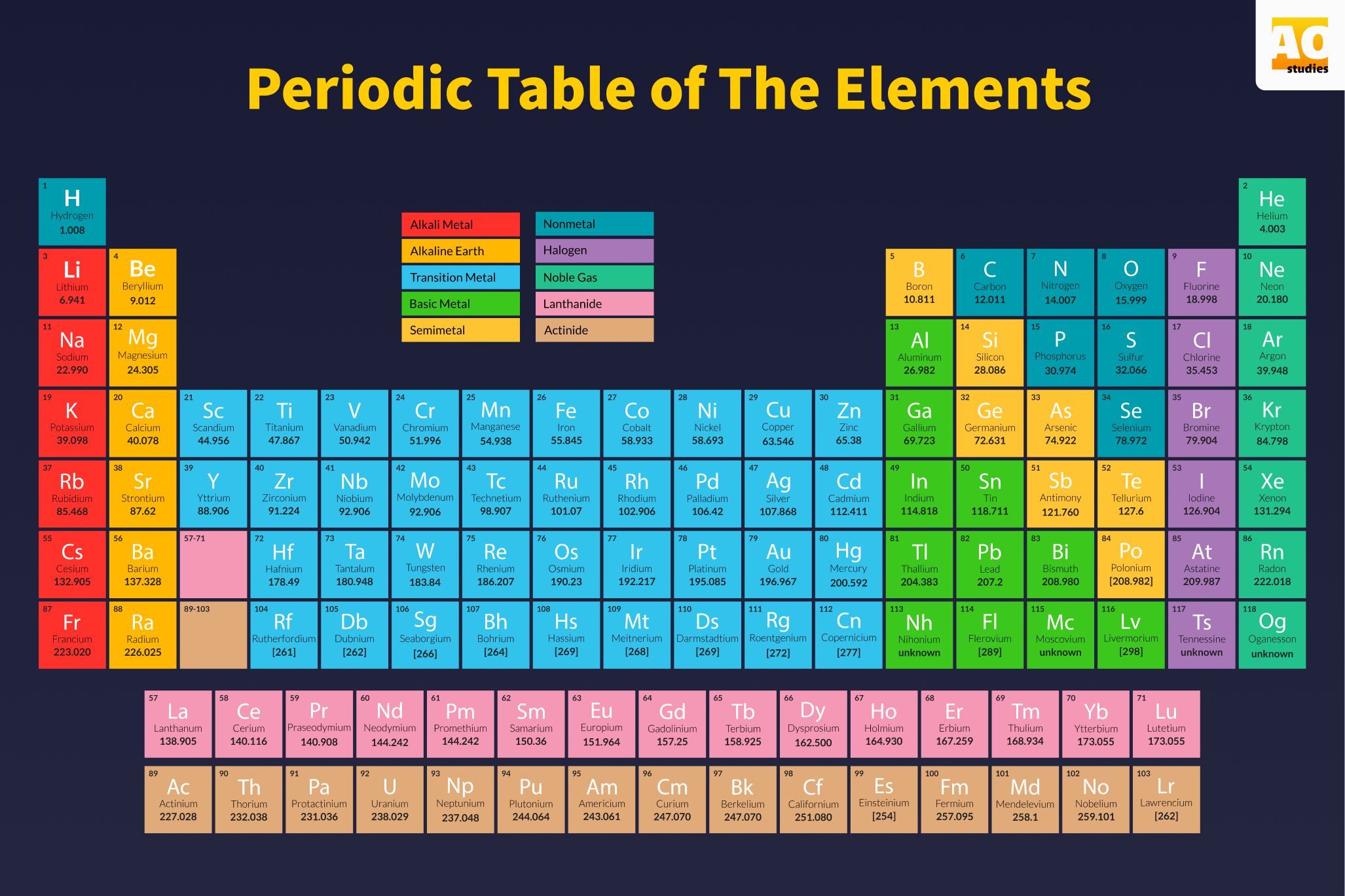
The periodic table lists all known chemical elements and is often used to assess students’ understanding of key Chemistry concepts, such as bonding, reactivity, and properties. Provided in both the Pure Science and Combined Science Singapore GCE O Level exam papers, students are expected to read, interpret, and apply the information accurately.
In this guide, we will cover everything you need to know about the O Level periodic table, including its structure, related exam question trends, and common mistakes students often make.
Before You Start Reading…
You might want to download our colour-coded periodic table to help with your studies!
Just click on the ‘Download’ button below to get started.
What Is the O Level Chemistry Periodic Table?
The periodic table of elements is a list of all 118 known chemical elements, arranged in ascending order of their atomic number, which is also known as the proton number. Every element occupies a fixed position in the table, and elements with similar properties are grouped together.
The origins of the periodic table can be traced back to 1869, when chemist Dmitri Mendeleev arranged the known elements by atomic mass, subsequently discovering patterns and relationships among them. Today, the modern periodic table is organised by atomic number and is referenced by students to understand the properties, trends, and behaviour of different elements.
Understanding the Layout of the Periodic Table
Understanding Periods (Rows)
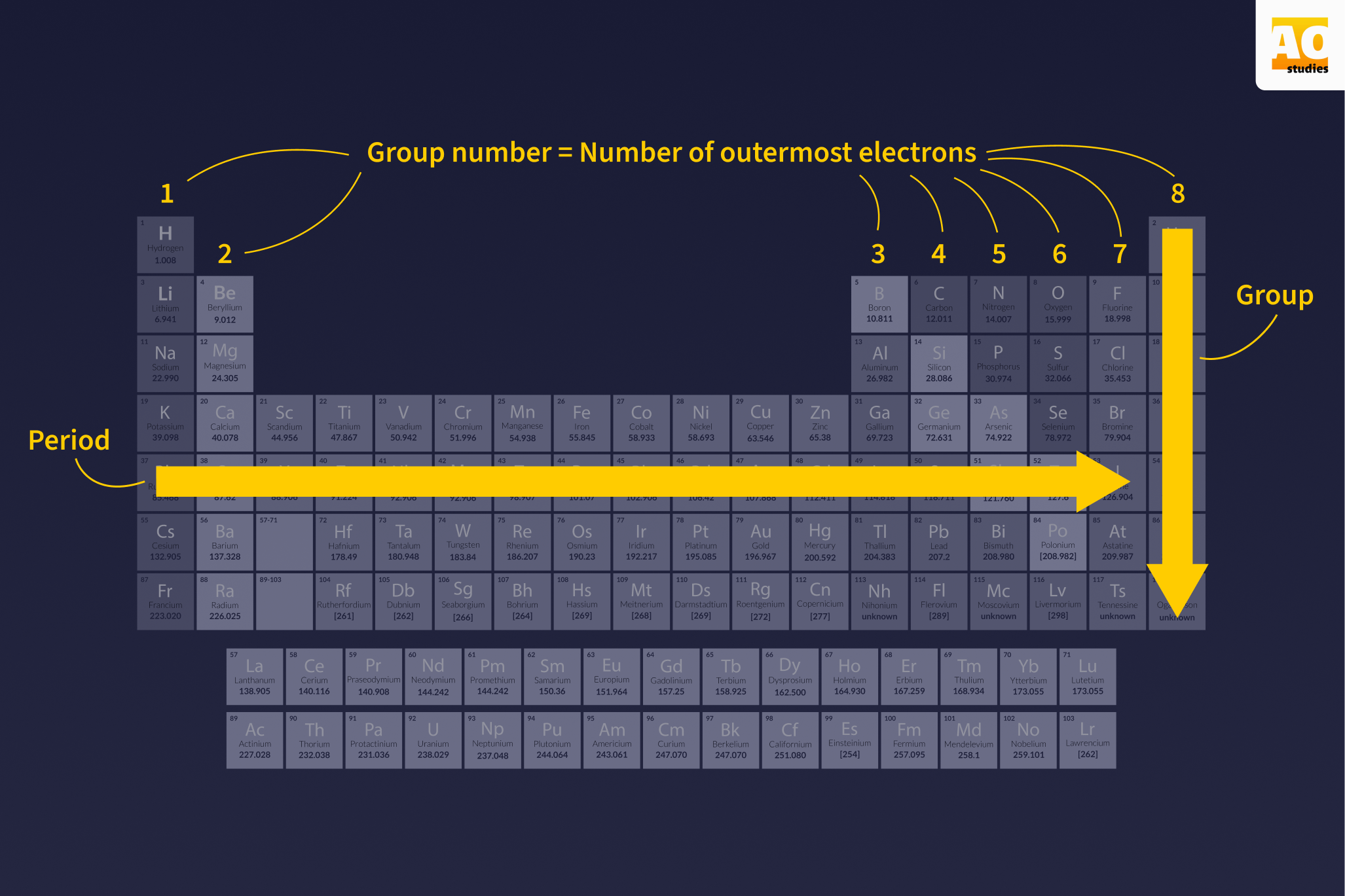
Periods are the horizontal rows of the periodic table. Period numbers represent the number of electron shells in an atom of each element. Although the table may appear to have 9 rows of elements, the two bottommost rows, the Lanthanides and Actinides, are actually a part of periods 6 and 7, respectively, and are displayed separately to keep the table compact.
Example: Sodium (Na) is found in Period 3, which means it has 3 electron shells. On the other hand, gold (Au) is found in Period 6 and has 6 electron shells.
Reading Groups (Columns)
Also known as families, groups are the vertical columns of the periodic table. There are 18 groups in total, and each element’s group number indicates the number of valence electrons (number of electrons in the outermost shell). Elements in the same group generally share similar properties, such as electronegativity and conductivity.
Example: Lithium (Li), sodium (Na), and potassium (K) are all Group 1 metals, meaning they have one valence electron and share similar chemical properties.
Understanding an Element Box
Atomic Number
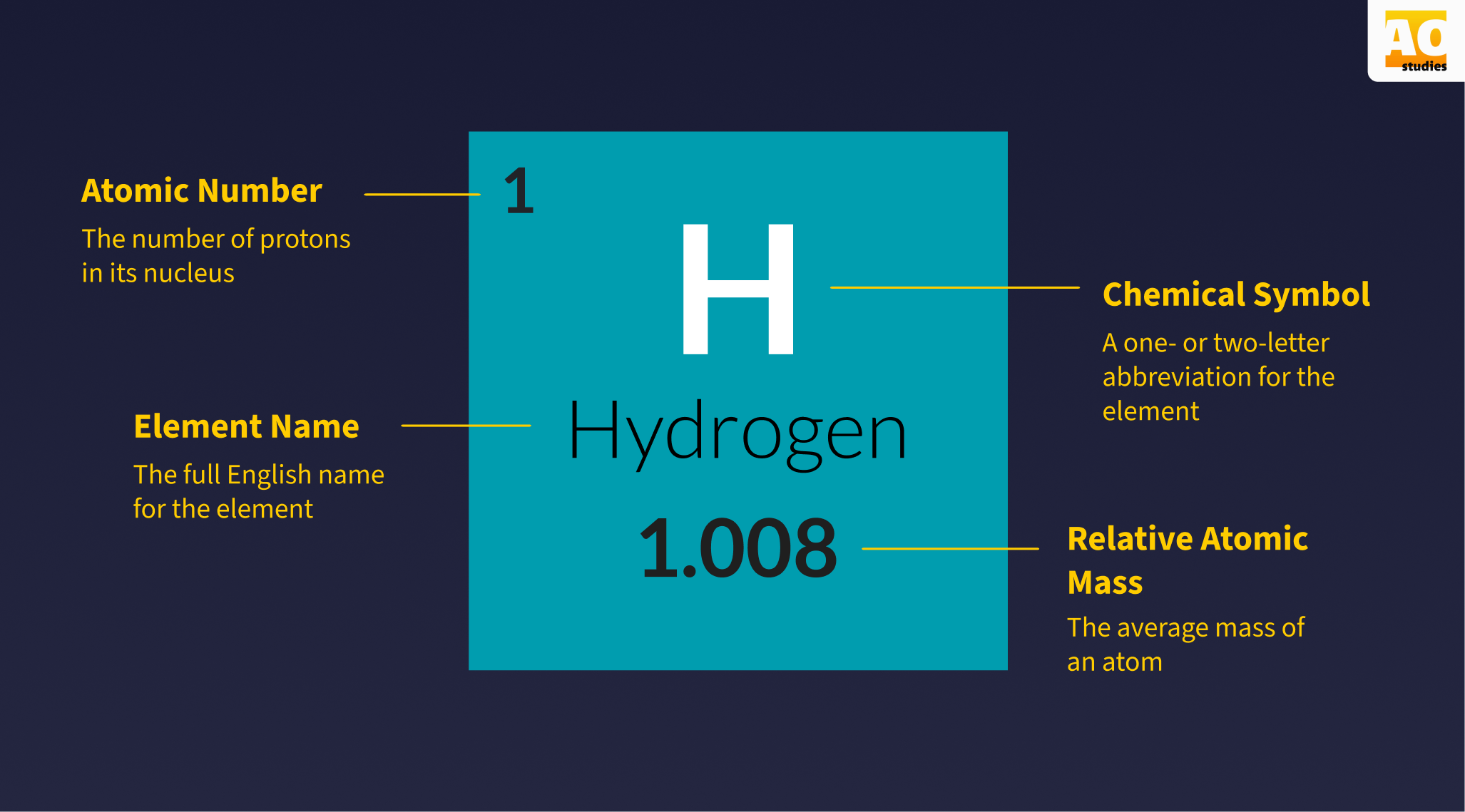
The atomic number represents the number of protons in an atom’s nucleus and determines the element’s position in the periodic table. No two elements have the same atomic number.
Chemical Symbol
The chemical symbol is a shorthand notation for every element, often derived from the English or Latin names for each element.
Relative Atomic Mass
The relative atomic mass is the weighted average of an element’s atoms, relative to the mass of Carbon-12.
Element Name
The element name is the element’s full English name.
Metals, Non-metals and Metalloids
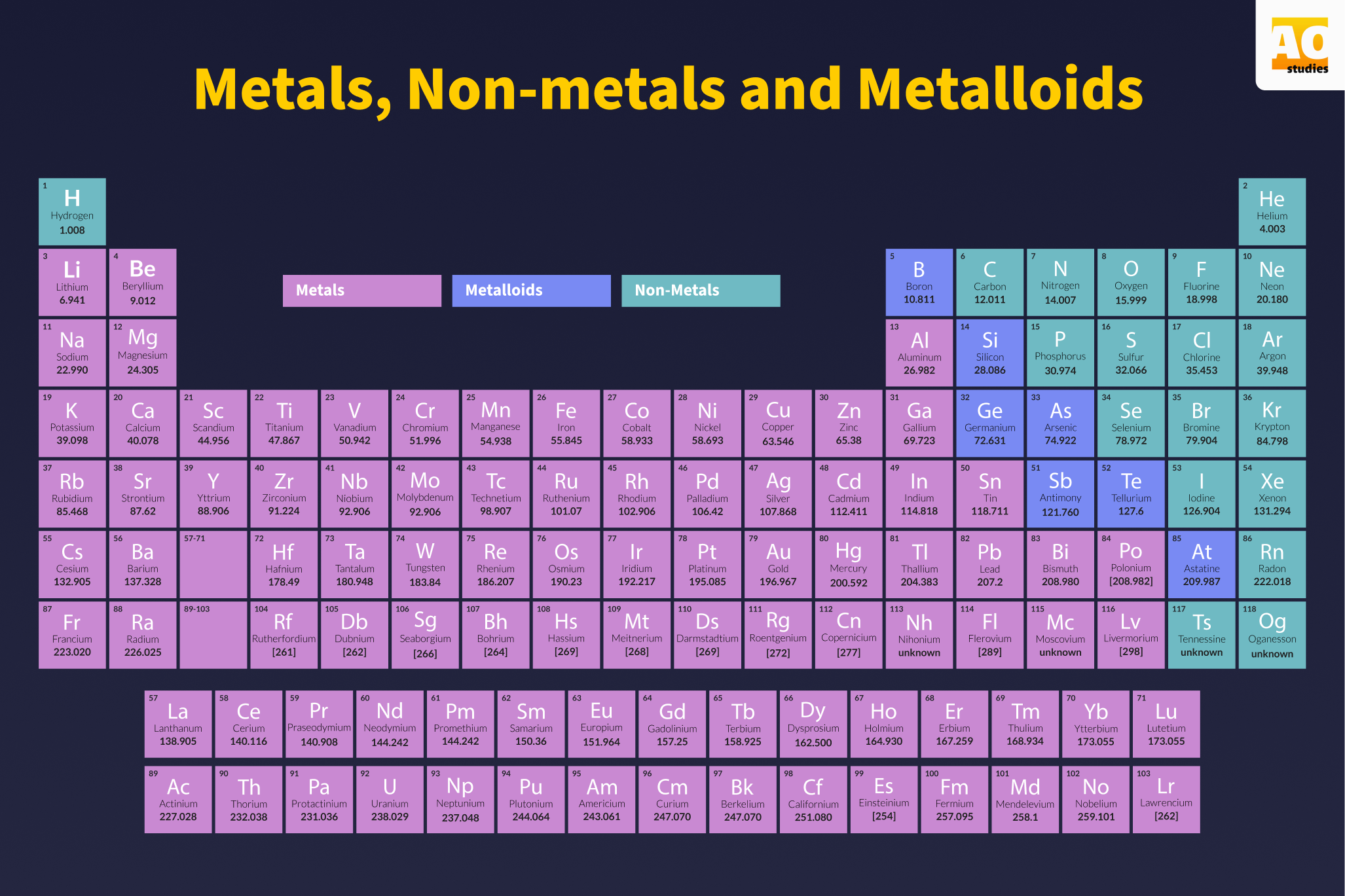
The periodic table can be divided into metals, non-metals, and metalloids. Metals occupy the left and centre of the table (with the exception of hydrogen), non-metals take up the right side, and metalloids form a slanted line between the two.
In general, metals have high melting and boiling points, have good heat and electricity conductivity, and tend to lose electrons to form positive ions. In comparison, non-metals generally have the opposite characteristics, often being poor conductors of electricity and heat. They also have higher electronegativity, allowing them to gain electrons to form negative ions.
Metalloids share both metal and non-metal properties and are often semiconductors, meaning they conduct electricity better than non-metals but not as well as metals. Unlike metals and non-metals, metalloids do not have a fixed tendency to gain or lose electrons, as their behaviour depends on the element and the chemical reaction involved.
Key Groups Every O Level Chemistry Student Should Know
Understanding the core groups in the periodic table is essential for O Level Chemistry students. In this section, we offer curated notes on the groups covered in the syllabus, including their physical and chemical properties, reactions, and trends.
Group I (Alkali Metals)
Also known as alkali metals, Group 1 elements have only one valence electron, meaning that they share similar physical and chemical characteristics. Some of the Group 1 elements include lithium (Li), sodium (Na), and potassium (K).
Physical Properties
- Shiny and silvery when cut, but oxidises quickly when exposed to air
- Soft solids that can be cut with a knife
- Low density, with some elements being so light they can float on water
- Low boiling and melting points
- Good conductors of heat and electricity
Chemical Properties
- One valence electron, which is lost to create a +1 ion
- Highly reactive to water and air, which is why Group 1 elements are usually stored in oil or a vacuum
Common Reactions
| Reactions | Products |
| When reacting with water | Forms metal hydroxide and hydrogen gas |
| When reacting with non-metals | Forms ionic compounds |
| When reacting with acid | Forms salt and hydrogen gas |
| When reacting with chlorine or air (O2) | Forms metal chloride or metal oxide |
Key Trends
| Trend | Explanations | |
| Reactivity | Increases down the group | As the number of electron shells increases ↑, the atomic radius also increases ↑. Thus, the attractive forces between the valence electron and the nucleus decrease ↓, making it easier to lose an electron to form a cation (positively charged ion). |
| Melting / Boiling Point | Decreases down the group | As the number of electron shells increases ↑, the atomic radius increases ↑. Thus, the attractive forces between delocalised electrons and the nucleus decreases ↓, lowering the energy needed to overcome the metallic bond during melting and boiling ↓. |
| Density | Increases down the group | Density generally increases down the group, with some exceptions. For instance, potassium (K) is less dense than sodium. |
Group VII (Halogens)
Group 17 elements are known as halogens and are highly reactive non-metals with distinctive properties. With 7 valence electrons, they are one electron short of achieving a stable electronic configuration. Thus, they exist as diatomic molecules (e.g. F₂), with each atom sharing one electron to achieve electronic stability.
Some halogens include fluorine (F), chlorine (Cl), bromine (Br), and iodine (I).
Physical Properties
- Stronger colouring down the group, as fluorine is pale yellow, chlorine is yellow-green, bromine is brownish-red, and iodine is dark grey
- Low melting and boiling points
- Poor conductors of electricity
- State at room temperature changes down the group, fluorine and chlorine exist as gases, bromine is a liquid, and iodine is a solid
Chemical Properties
- Seven valence electrons, with a tendency to gain one to form a -1 ion
- Highly reactive with water and air, which is why Group 17 elements are usually stored in oil
Common Reactions
| Reactions | Products |
| When reacting with metals | Forms ionic compounds (metal halide) |
| When reacting with non-metals | Forms covalent compounds |
Key Trends
| Trend | Explanations | |
| Reactivity | Decreases down the group | As the number of electron shells increases ↑, the atomic radius also increases ↑. Thus, the attractive forces between the valence electron and the nucleus decrease ↓, making it harder to gain an electron to form an anion (negatively charged ion). |
| Melting / Boiling Point | Increases down the group | As the number of electron shells increases ↑, the atomic radius and number of electrons increase ↑. This strengthens the intermolecular forces of attraction between molecules ↑, so more energy is required to overcome these attractive forces during melting and boiling ↑. |
| Density | Increases down the group | Density generally increases down the group, with some exceptions. |
Halogen Displacement Reactions
The halogen displacement reaction is a key concept in the O Level syllabus and refers to a process in which a more reactive halogen displaces a less reactive halide ion from its compound or solution. As seen from the table above, the reactivity decreases down the group, meaning that fluorine is the most reactive halogen, followed by chlorine, bromine, and iodine.
Example: When chlorine gas is added to a salt solution with bromine ions, the chlorine will displace the bromine to form chloride ions and bromine. Here is the chemical equation: Cl2(aq)+2Br−(aq)→2Cl−(aq)+Br2(aq)
Group VIII (18) Noble Gases
Group 18 elements are known as the noble gases and are unique because they have fully filled valence electron shells. This allows them to exist as monoatomic gases, meaning they consist of single atoms rather than molecules, as they are extremely stable and generally unreactive.
Some of the group 18 elements include helium (He), neon (Ne), argon (Ar), and Krypton (Kr).
Physical Properties
- Colourless gases at room temperature
- Very low melting and boiling points
- Exist in a monoatomic structure (single atoms, not molecules)
Chemical Properties
- Extremely low reactivity and are essentially inert for O Level Chemistry purposes
Use of Noble Gases
Noble gases are widely used for their low reactivity. For example, neon glows when electrically excited and is used in advertisement boards, while helium is used in balloons as it has a low density and is non-flammable.
Transition Elements
Transition elements are found in the central block of the periodic table, between groups 2 and 13. They are metals and exhibit interesting properties compared to other elements. Some key transition elements in O Level Chemistry include iron (Fe), zinc (Zn), copper (Cu), and nickel (Ni).
Physical Properties
- High melting and boiling points
- High density
- Hard, malleable, and ductile
- Good conductors of heat and electricity
Chemical Properties
- Has variable oxidation states (e.g. iron can form Fe²⁺ or Fe³⁺ ions)
- Forms coloured compounds and ions in solutions (e.g. copper sulphate solution is blue; iron(III) chloride solution is yellow-brown)
- Are good catalysts due to their ability to be oxidised
Importance of Transition Elements
Transition elements are important because they have a wide range of industrial and everyday applications. Their strength and durability make them useful in construction and manufacturing, while their ability to act as catalysts speeds up many chemical reactions.
Applying the Periodic Table in O Level Chemistry Questions
The periodic table is an important topic in the O Level Chemistry syllabus and plays an essential role in students’ understanding of Chemical concepts and problem-solving skills. By recognising trends and patterns within the periodic table, students can expect to apply their knowledge in an exam in several ways, including:
Predicting Chemical Bonding
Use an element’s position in the periodic table to determine whether it is likely to form ionic or covalent bonds.
Determining Valency
Identify an element’s valency based on its group to predict how it combines with other elements.
Predicting Reactivity
Apply periodic trends to compare the reactivity of elements within the same group or across a period.
Writing Chemical Formulae
Use the elements’ chemical symbols and valencies to write the correct chemical formula for compounds.
Balancing Chemical Equations
Balance chemical equations by applying chemical formulae and the law of conservation of mass.
Common Mistakes Students Make When Using the Periodic Table
Without a strong understanding of the periodic table, students are prone to making many avoidable mistakes. Here are some of the common pitfalls students experience:
- Confusing Groups and Periods: Mixing up vertical groups and horizontal periods can lead to incorrect predictions about an element’s properties.
- Mixing Up Valency and Ion Charges: Confusing an element’s valency with the charge of its ions often results in incorrect chemical formulae.
- Misidentifying Metals and Non-Metals: Failing to distinguish between metals and non-metals can lead to errors in predicting chemical bonding.
- Ignoring Periodic Trends: Overlooking trends such as reactivity or atomic size makes it harder to answer application-based questions accurately.
- Relying on Memorisation Instead of Understanding: Memorising facts without recognising periodic patterns makes it difficult to solve unfamiliar exam questions.
Master the Periodic Table for your O Levels with AO Studies
As a leading O Level tuition centre in Singapore, AO Studies has an excellent track record of helping students excel, with 100% of our Combined Science students and 80% of our Pure Science students achieving B3 grades or above.
With over 90% of our students joining through referrals, every Chemistry class is taught by our experienced ex-MOE tutor. Lessons are intentionally kept to a maximum of 14 students, providing every young learner with personalised attention to gain an in-depth understanding of foundational concepts. Students also benefit from our curated notes and conducive study area, helping them score in their O Level exams while inspiring future chemists.
FAQs – Periodic Table for O Level Chemistry
Can I use the periodic table during the O Level Chemistry examination?
Yes, the periodic table is provided in the O Level Chemistry examination booklet, so students will not need to memorise or bring their own copy to the exams.
Do I need to memorise the elements in the periodic table?
No. Students are provided with a copy of the periodic table during the O Level Chemistry examination, so there is no need to memorise elements. However, it is highly recommended to be familiar with the positions of common elements, their symbols, and the trends across groups and periods, as this will help you answer questions more efficiently.
Which groups and properties of elements are most important for O Level Chemistry?
For the Singapore O Level Chemistry syllabus, students should have a strong understanding of the properties and trends of Group I (alkali metals), Group VII (halogens), Group VIII (noble gases), as well as transition elements. Key concepts include physical and chemical properties, reactivity trends, electronic configuration, as well as how to interpret an element’s position in the periodic table in relation to its properties.
Where can I download the O Level Chemistry periodic table PDF?
You can download the O Level periodic table here
Have there been any updates on the periodic table?
The modern Periodic Table is occasionally updated by the International Union of Pure and Applied Chemistry (IUPAC) when new elements are officially discovered and named. However, these updates rarely affect the Singapore O-Level Chemistry syllabus. Students should study the Periodic Table provided in the latest SEAB syllabus, as this is the version relevant to their examinations.
I am interested in joining AO Studies. How do I sign up?
You can sign up for a free trial class in our online form. Alternatively, if you have any questions, you may contact our lead tutor, Mr Joseph, through WhatsApp or via his email address at [email protected].